The 888 Women's History Project Presents

A Film By Susan Rivo
Edited By Iftach Shavit
The Women’s Center in Cambridge, Massachusetts, founded in 1971, is now the oldest continuously operating community Women’s Center in the United States and possibly the world. Throughout its history, the Center has provided the needed safe space for new, creative and path breaking groups to emerge and develop.
The 888 Women’s History Project was formed in 2001 to document and preserve this extraordinary history, from the years just before and after the establishment of the Women’s Center through the development of the innovative projects and support groups which began there. Most of the women who were involved in the Center’s early years are still alive and many of them still live in the Boston area. Most of the physical records of the early years, such as meeting announcements and minutes, articles by and about the Center which appeared in now defunct community papers, personal journals, photographs, and other materials are not yet collected in a central repository. The organization has been systematically contacting women who were involved in the founding of the Women’s Center and the development of its projects to record their memories and to request that originals or copies of any related documents be donated for archival preservation.
The original participants in the 888 Women’s History Project’s work were all involved in the early years of the Women’s Center and include both a professional historian and an archivist. Each volunteers her time and energy to make this history accessible to any interested person.
Our first project, which we began to research and plan in 2001, is the documentary film “Left on Pearl: Women Take over 888 Memorial Drive, Cambridge.” A chief purpose of women’s history remains making visible what is invisible or obscured in the shadows. Massachusetts, especially the Boston and Cambridge areas, was one of the germinal centers of early Second Wave feminism. In our film, “Left on Pearl: Women Take Over 888 Memorial Drive, Cambridge,” we focus on a unique action, a women-led building takeover which involved feminists, community activists, and Harvard University officials. The takeover received significant media attention at the time. Through this local action our documentary, Left on Pearl is able to reflect and amplify significant themes of the larger women’s liberation movement in the U.S.
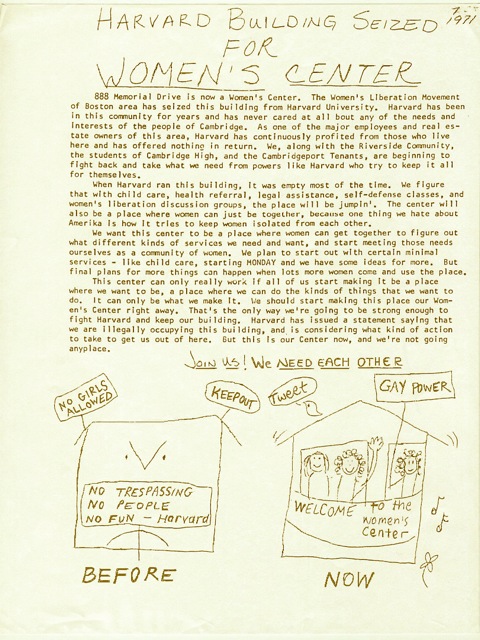
On March 6, 1971, the building at 888 Memorial Drive in Cambridge, Massachusetts, was the site of a battle between a determined group of women and Harvard University. In a ‘surprise ending’ to that year’s International Women’s day rally, featuring speeches linking women’s concerns in the U.S. with global struggles against the Vietnam war and apartheid in South Africa, hundreds of demonstrators marched from Boston into Cambridge. The police expected them to proceed to Harvard Square, the usual ending point for marches. Instead, carrying banners and singing protest songs, the marchers turned left on Pearl Street, and occupied a Harvard-owned warehouse to dramatize the need for a Women’s Center.
888 Memorial Drive, a former knitting factory located 1.5 miles from the Harvard campus, was Harvard University’s temporary Architectural Technology Workshop while a new Design School building was under construction. Once the Design School was up and running, the University had planned to demolish this warehouse to make way for student dormitories. 888 Memorial Drive and the adjacent open space also owned by Harvard, was collectively called Treeland, for the garden store that leased space there. Treeland, which sat on the last bit of open riverfront space in the neighborhood, was being sought by community activists for affordable housing. The predominantly low–income African American community of Riverside felt that the university should build affordable housing on this property to replace some of the hundreds of housing units that had been lost to its expansion into Riverside.
The women who took over 888 Memorial Drive addressed issues still relevant today, for women and for the surrounding community. The occupiers’ first press release included demands for childcare, health referral, legal aid, self-defense, and a safe space for lesbians, as well as support for community demands for low-income housing, better education of black high school students, and an end to police brutality. Ten days later, the occupiers walked out triumphantly, having won funding for the purchase of a building for a Women’s Center. Almost forty years later, Harvard completed a dormitory building, affordable housing units and an open access park on the footprint of 888 Memorial Drive. The city of Cambridge has installed a plaque commemorating the 1971 takeover.
The takeover and its aftermath are little known today. Yet its legacy remains in the Women’s Center, founded in 1972 as a result of the takeover, and the community organizations that it has nourished. Many pioneering feminist projects got their start at the Women’s Center: an early rape crisis center; the first Massachusetts shelters for battered women and their children and for women recovering from mental illness; a pregnancy counseling service; a women’s school offering instruction in self-defense, auto mechanics, and women’s history; the women’s community cancer project; an incest survivors group; various programs for lesbians; computer literacy and financial counseling services, among others. The Women’s Center, which occupies a large house in central Cambridge, continues to draw women and girls from the greater Boston area. Community organizations such as City Life/La Vida Urbana were founded by women who were part of the 1971 takeover; today City Life is at the forefront of actions to block foreclosures in Boston.
In making a documentary about the takeover, we are fortunate to have access to a variety of resources from this period, including rare archival footage: a 16mm film of the march and the takeover, television newsreels, and coverage from local, national and international newspapers. Most of the participants are still alive. We have completed over forty interviews with participants in the takeover, community activists, and Harvard personnel. Some of those involved have died; the memories of others are fading. We feel a great urgency to find and interview those who stood on various sides of this historic action and to complete our film.